After a day at a desk, a long journey or an uncomfortable night, your back and neck can feel “compressed”. A few gentle stretches, or a few minutes lying on the right support, help release your upper body without complicated equipment.
Here is the difference between active stretching and passive support, simple positions to start with, a sensible duration, and how to choose between a neck support and a back stretcher.
Active stretching or passive support: what's the difference?
An active stretch is one you do yourself: you tilt your head, round then arch your back, control how far you go and stop whenever you like. It needs no equipment and fits easily into a break.
A passive support works the other way round: you lie on it and your body weight does the work. The shape of the support guides you into a gentle stretch that you hold for a few minutes, breathing calmly. It is often more restful, especially at the end of the day, but how far it stretches depends on the support: hence starting with the gentlest setting.
The two go well together. The UK's National Health Service (NHS) lists exercises and stretches among the simple things you can do for your back, and flexibility exercises for the neck, and points out that it is better to keep moving than to stay in bed for long periods.
Simple positions to start with
Do these movements slowly, without jerking or bouncing. A stretching sensation is normal; pain is not: stop if it hurts.
For the neck
- Side tilt: sitting with your back straight, gently tilt your head towards one shoulder, hold for about twenty seconds, then switch sides.
- Rotation: slowly turn your head to look over one shoulder, then over the other.
- Chin tuck: draw your chin slightly backwards without dropping your head, hold for a few seconds, then relax.
For the back
- Round and arch: on all fours, round your back as you tuck your chin, then gently arch it as you look ahead, several times, in time with your breathing.
- Knees to chest: lying on your back, bring one knee, then both, towards your chest, holding them with your hands.
- Lying twist: on your back with knees bent, let both knees drop to one side, shoulders on the floor, then to the other.
For more gentle neck and shoulder movements, see our neck and shoulder relaxation routine.
How long, and how often?
There is no universal duration. In practice, a few minutes are enough: about twenty seconds per position, two or three repetitions, and a few minutes on a support. A short, regular moment, for example in the evening, is better than a long session once in a while.
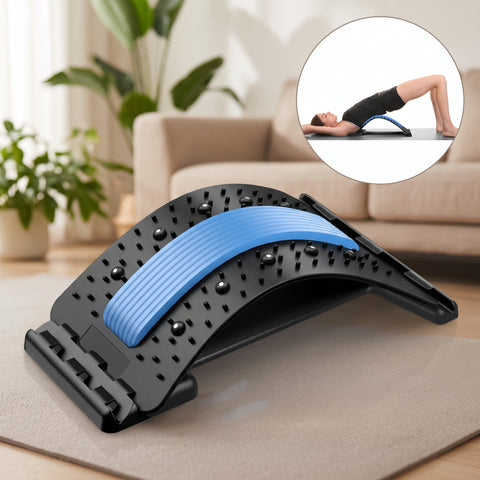
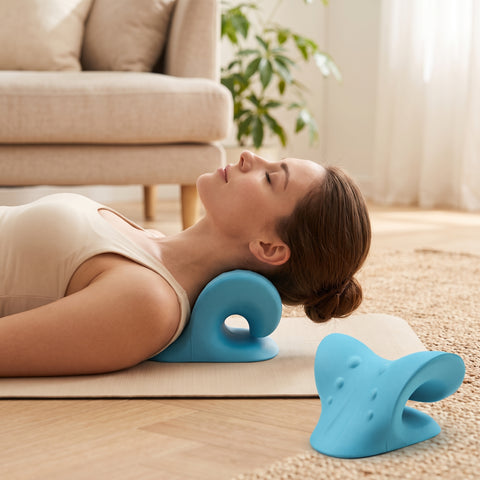
For a support, the instructions are your reference. For example, Komua 17 · Neck Stretching Support is used for about ten minutes and removed before you go to sleep; Komua 14 · Adjustable Back Stretcher is used for a few minutes, starting at the lowest height.
Neck support or back stretcher: how to choose?
The neck support, for the neck
A neck support goes under your neck while you lie on your back. The weight of your head is enough: the curve of the support guides a gentle stretch of the back of the neck. A neck stretching support made of dense C-shaped foam has two sides: a gentler one to start with and a firmer one afterwards. It is neither a pillow for the night nor a massager: it doesn't vibrate or heat up.
The back stretcher, for the back
A back stretcher sits on the floor: you lie on it with your knees bent, and its arched shape supports your back. An adjustable back stretcher clips onto a base with three heights, for a gentle, medium or more pronounced curve; a soft strip runs along the line of the spine. Start at the lowest level, and roll onto your side to get up.
And the acupressure mat?
An acupressure mat doesn't aim to stretch: you lie on its spikes with a cushion under your neck, and the pressure spreads across your whole back. Some people enjoy it as a moment to unwind before or after stretching. The sensation is unusual at first: you can keep a thin T-shirt on.
| Option | Area | How to use it | Best for |
|---|---|---|---|
| Active stretches | Neck and back | Sitting, standing or on the floor, a few minutes | Breaks during the day, no equipment |
| Neck support | Neck | Lying on your back, about 10 minutes | A gentle, effortless neck stretch |
| Adjustable back stretcher | Back | Lying down, knees bent, a few minutes, height of your choice | A guided, gradual back stretch |
| Acupressure mat | Back, neck with the cushion | Lying down, a few minutes | A moment to unwind, with spread-out pressure |
These supports are gathered in our neck, shoulders and back selection; pillows and cushions for resting are in our comfort and support selection.
When is a passive support better than a massage device?
A massage device works on the muscles through pressure, percussion or rotation: it suits you when you want a massage, on a specific area or hands-free. A passive support does nothing more than put you in a position: no motor, no intensity to set, no charging. It suits you when what you mainly want is to lie down and let go, quietly, for a few minutes.
The two aren't mutually exclusive: a neck massage in the evening, followed by a few minutes lying on a support, can make a simple routine. To compare massagers for this area, see how to choose a neck and shoulder massager.
Mistakes to avoid
- Starting with the firmest setting, or staying on too long the first time.
- Pushing a stretch until it hurts, or making sudden head movements.
- Falling asleep on a stretching support.
- Getting up in one go: roll onto your side, then sit up.
- Relying on an evening session instead of breaks: moving often is still the foundation, as our tips for screen work point out.
When should you see a doctor?
These moves are for everyday stiffness. Ask a doctor before using a stretching support if you have a back or neck injury or recent surgery, osteoporosis, a known spinal problem, or if you are pregnant. See a doctor if the pain lasts several weeks, gets worse, or comes with tingling, weakness, dizziness or fever.
Stop a stretch or support immediately if you feel dizzy or numb, or if the pain increases.