Retail, healthcare, kitchens, hairdressing, reception desks, workshops: many jobs are done standing up. Standing in itself isn't the problem; it's holding that position for a long time, in one place, without being able to sit down or move.
Here's what occupational health bodies recommend to make these days more comfortable: alternate positions, keep moving, pay attention to your shoes and work surface, then wind down properly at the end of the day.
Why standing for a long time becomes uncomfortable
Standing upright requires continuous muscular effort, especially in the legs and back. When you stay still, the working muscles get less blood flow and tire more quickly: heavy legs, sore feet, a stiff back or neck at the end of the day.
The European Agency for Safety and Health at Work (EU-OSHA) defines prolonged standing as more than one hour without a break, or more than four hours in a day. When it is repeated, it is associated with leg and foot pain, lower back pain, fatigue and varicose veins.
Change position regularly
The most important principle is simple: your best posture is the next one. The idea isn't to replace standing with sitting, but to alternate between the two, with moments of movement in between.
- A seat within reach: a chair, a high stool or a sit-stand seat lets you lean or sit for a moment, even if the job is mostly done standing.
- A foot support: a rail or a small footrest lets you rest one foot and then the other, and shift your weight from one leg to the other.
- A work surface at the right height, so you don't work leaning forward or with your arms raised.
| Type of task | Work surface height (reference point: your elbows) |
|---|---|
| Precision work | About 5 cm (2 in) above elbow height |
| Light work | 5 to 10 cm (2 to 4 in) below elbow height |
| Heavy work | 20 to 40 cm (8 to 16 in) below elbow height |
These reference points come from the Canadian Centre for Occupational Health and Safety. According to INRS, the French occupational health and safety institute, it is first and foremost the way work and workstations are planned that limits prolonged standing. If your workstation doesn't let you alternate, talk to your employer or your occupational health service.
Move and take short breaks
When standing can't be avoided, "active" standing is better than standing still: take a few steps, shift your weight, work your ankles.
- A mini-break every 30 minutes to walk a little, as EU-OSHA recommends.
- Regular seated breaks to rest your legs, rather than a single long break.
- A few simple movements: rise up onto your toes and lower back down, circle your ankles, bend your knees slightly.
- Vary your tasks when possible, alternating between those done standing, sitting and walking.
Shoes and work surface
Shoes matter a lot when you spend the day on your feet. The Canadian Centre for Occupational Health and Safety recommends shoes that:
- follow the shape of your foot and leave room for your toes;
- hold the heel firmly and support the arch;
- are cushioned, possibly with a small heel, but no high heels;
- have well-adjusted laces, so your foot doesn't slide.
On a hard floor (concrete, tiles, metal), cushioned insoles or an anti-fatigue mat can reduce discomfort: INRS rates the evidence as moderate, and points out that these solutions are only a complement to well-planned work. Choose a mat with sloped edges that won't trip you up, and avoid foam that's too thick: too much cushioning can be tiring too.
What to do at the end of the day
In the evening, your legs and feet mainly need rest. Sit down, take off your shoes and raise your legs on a cushion or footstool: this is also the first piece of advice from the UK's National Health Service (NHS) when your ankles are slightly swollen after a long day on your feet. A short, easy walk also helps you loosen up.
For a detailed evening routine, see what to do when your feet are tired after standing all day, and to switch off from work more broadly, our after-work relaxation routine.
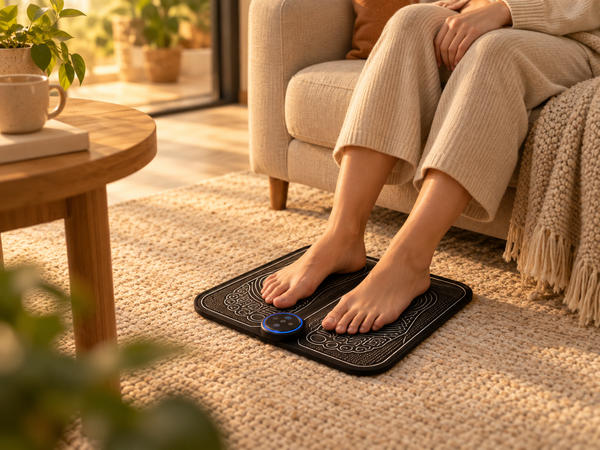
Some people also like to sit for a few minutes with their feet resting on a massage mat like Komua 01 · Foot Massager: a moment of comfort at home, not a treatment. It's an electrode device: read its user manual, and ask for medical advice if you have a pacemaker or another implanted device, or if you are pregnant or have epilepsy.
When discomfort calls for professional advice
Feeling tired in the evening is common. See a doctor:
- if swelling in your ankles or legs doesn't improve after a few days of rest, or gets worse;
- if pain in your feet, legs or back persists, comes back every day or gets worse;
- if you have diabetes and your feet or legs swell.
Seek medical help quickly if only one leg swells for no obvious reason, if the swelling is sudden, significant or painful, or if the skin becomes red or warm. Call your local emergency number if you are short of breath or have chest pain or tightness.
If you are pregnant, EU-OSHA recommends limiting the time you spend standing each day: talk to your doctor and your occupational health service.