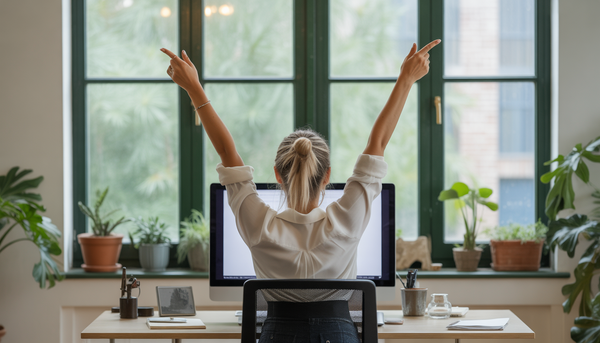
For the back of the neck and the upper shoulders, the choice mostly comes down to a practical question: do you want to keep your hands free, or guide the device yourself? A massager that rests on your shoulders suits an effortless seated break. A handheld device targets a muscle more precisely, but you have to raise your arms to reach your own neck.
Then come more concrete criteria: how it stays in place, the controls, the power source, the weight and cleaning. This guide goes through them, along with what research says about neck massage and the precautions to know.
What are the main types of neck and shoulder massagers?
The massager worn on the shoulders
It rests on your shoulders, held in place by a strap or handles, and its massage heads sit against the back of the neck and the upper shoulders. Its appeal is that it leaves your hands free: you can read or rest while it runs. On the other hand, its shape determines the area it massages.
The handheld device
Whether it's a massage gun or a massager with a handle, you move it yourself over the area you choose. It's the most precise option, but also the least comfortable for your own neck: your arms tire quickly and the angle is hard to find.
The massage cushion
It sits between your back and the backrest of a chair or sofa, and you lean against it. It's better suited to the upper back; how well it works depends a lot on the seat and your position.
| Format | Use | Strengths | Limitations |
|---|---|---|---|
| Worn on the shoulders | Seated, without holding anything | Hands-free, an easy break to take | Area massaged set by the shape of the device |
| Handheld (including massage guns) | You guide the device | Precise, also suits other muscles | Tiring for the arms, neck hard to reach on your own |
| Cushion placed against a backrest | Leaning against the seat | Simple, nothing to hold | Depends on the seat, mainly for the upper back |
The criteria that really matter
Staying in place
A wearable massager should stay in place without you having to hold it. A strap or handles let you adjust the pressure by pulling more or less. The massage heads should sit on the upper shoulders and the sides of the neck, never on the front of the neck.
Controls
The buttons should be easy to reach once the device is in place, so you can lower the intensity or switch it off without taking it off. If several levels are available, always start with the lowest.
Power source
A cordless device moves freely from the desk to the sofa, but you have to remember to charge it. A plug-in model doesn't have that issue, at the cost of a cable that limits your movements. The user manual states the charging time and the recommended length of use.
Weight and size
A wearable device rests on your shoulders for several minutes: a heavy model is quickly felt. Think about storage too, if the device is to stay within reach.
Cleaning
The parts in contact with the skin should be easy to clean, following the user manual.
What about heat?
Some models add a heating function. It isn't essential for massage. If your device has one, the precautions are the same as with a hot water bottle: on healthy skin, without falling asleep with it, and stopping if it gets too hot.
Hands-free massager or massage gun?
The two don't meet the same need. A massage gun taps the muscle with short, rapid strokes; it suits large muscle groups (thighs, calves, upper back) and needs to be guided carefully. It's rarely used on the neck: the area is small, close to the spine and hard to reach on your own. To get the most out of it on other muscles, see how to use a massage gun.
A wearable massager, on the other hand, is designed for this specific area and for a moment of rest: you put it on, sit down and let it run. If what you mainly want is to unwind at the end of the day, it's usually the simplest format.
When is a neck and shoulder massager practical?
- At the end of a day spent sitting, to take a few minutes' break without any effort.
- When there's no one around to give you a massage: the back of the neck and the upper shoulders are hard to massage yourself.
- Alongside a routine to relax your neck and shoulders: moving more often and doing a few gentle movements remain the foundation.
What research says
According to the U.S. National Center for Complementary and Integrative Health (NCCIH), massage may help with neck or shoulder pain, but its benefits sometimes last only a short time. A meta-analysis of 15 trials (1,062 participants) found a moderate effect on neck pain compared with no active treatment, but no evidence of an improvement in day-to-day functioning, nor sufficient data on a lasting effect.
This research covers massage given by professionals, not devices: it can't be used to infer the effect of an electric massager. A device is first and foremost a way to take a moment to relax at home.
Precautions and when to ask for advice
- Read the user manual and stick to the length of use it states.
- Start at the lowest intensity: a massage should not hurt. Stop if pain appears or gets worse.
- Don't use the device on the front of the neck, directly on the spine or on damaged skin.
- Tie back long hair and remove necklaces, scarves and loose clothing: in the United States, a shiatsu-type neck and back massager was recalled in 2011 because its rotating mechanism could catch clothing, accessories and hair.
- Don't fall asleep with the device running, and don't use it while driving.
The risk of side effects from massage is low, but serious side effects have rarely been reported, mostly with vigorous massage and in more vulnerable people, such as older adults. Ask for medical advice before using a device if you have a known health condition or a recent injury, and see a doctor:
- if the pain or stiffness doesn't improve after a few weeks;
- if you feel tingling, a cold sensation in your arm or a loss of strength;
- after a fall or a knock.
A massager replaces neither a diagnosis nor care from a healthcare professional.
What about Komua 04?
Komua 04 · Neck & Shoulder Massager belongs to the wearable massager family: it rests on your shoulders, is held in place with a strap and is cordless. Its hand-shaped massage heads sit on the back of the neck and the upper shoulders, and its buttons are on the device itself. It's designed for a hands-free break at home, alongside breaks and movement, not instead of them.
Still undecided between several areas or devices? Our guide how to choose a massage device compares them.