Self-massage doesn't have to involve an electric device. A roller, a ball, a wrap-around roller or a mat let you massage your own muscles, using your body weight or the strength of your hands, with no battery and no settings.
These four formats aren't for the same thing. Here is how they work, which areas they suit, what we know about their effects, and how to choose for your needs.
The four formats at a glance
| Format | Areas | How to use it | Ideal for |
|---|---|---|---|
| Roller | Large areas: thighs, calves, glutes, back | Placed on the floor, you roll over it | Self-massage after exercise or at the end of the day |
| Ball | A precise spot: sole of the foot, shoulder, glute | On the floor, against a wall or in your hand | A localised area that's hard to reach with a roller |
| Wrap-around roller | Calves, thighs, arms | Sitting, you guide it by the handles | Massaging both sides of a limb without getting on the floor |
| Acupressure mat | Back, neck with the cushion | You lie on it without moving | A moment to unwind, with spread-out pressure |
The roller, for large areas
A massage roller (often called a foam roller) sits on the floor. You place the area on it, then roll slowly back and forth, controlling the pressure with your hands or feet. It suits large muscle groups: thighs, calves, glutes, upper back.
It's the best-studied format. A 2019 meta-analysis of 21 studies found that, after exercise, rolling slightly reduced perceived muscle pain and slightly limited the drop in performance; before exercise, it brought a small gain in flexibility. The effects remain modest, and the studies involved healthy, active people.
Komua 16 · 3D Massage Roller, made of EVA foam with a 3D surface, is compact (about 26 × 8 cm) and can be rinsed with water. Avoid rolling directly over joints, the spine and the front of the neck.
The ball, for a precise spot
A ball concentrates pressure on a small surface. You place it under the sole of your foot, against a wall at shoulder level or on the floor under a glute, then roll it in small circles, controlling the pressure with your body weight.
A spiky massage ball of about 4.5 cm slips into a pocket: handy at the office, under your foot, or when travelling. It complements a roller rather than replacing it: the ball for the precise spot, the roller for the whole area.
The wrap-around roller, for arms and legs
A wrap-around roller encircles the limb. Sitting down, you open it slightly, place it around your calf, thigh or arm, then slide it along by its handles: its rollers massage both sides at once. You control the pressure by squeezing more or less.
Komua 20 · Wrap-Around Massage Roller suits people who'd rather not get down on the floor, or who want to massage their legs in front of the TV. It isn't a format for the back.
The acupressure mat, for a moment to unwind
An acupressure mat works differently: you don't roll, you lie down. Its spikes spread a static pressure across your whole back, and a matching cushion goes under your neck. The sensation is intense for the first few minutes, then often eases; you can keep a thin T-shirt on at first.
Studies on these mats are still scarce: it's best seen as a moment to unwind rather than a recovery tool. Komua 15 · Acupressure Mat with Cushion measures about 68 × 42 cm and rolls up into its bag. It fits easily into a relaxation corner at home.
How to choose for your needs
- You do sport and want to self-massage after exercise: start with the roller, plus a ball for precise spots.
- You mostly feel one precise spot (sole of the foot, shoulder): the ball.
- You want to massage your legs without getting on the floor: the wrap-around roller.
- You mainly want to lie down and let go: the acupressure mat, or a support to stretch your back and neck.
What if you prefer an electric device?
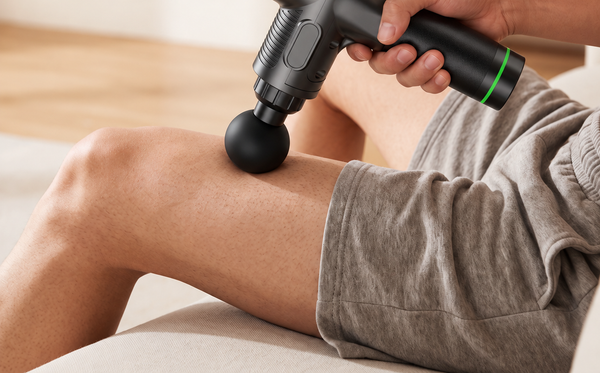
For large areas, a massage gun does a job similar to the roller's, through percussion: see how to use a massage gun. For a small area, a pulse massage pen is placed on a precise point of the hands, arms or shoulders; like any device that uses electrical pulses, it must not be used if you have a pacemaker, are pregnant or have epilepsy.
Manual formats and electric devices are gathered in our body massage selection.
Good habits, whatever the format
- Keep the pressure pleasant: brief discomfort can be normal, sharp pain is not.
- Move slowly, and don't stay long on a very tender spot.
- Avoid bones, joints, the spine, the front of the neck and any damaged skin.
- A few minutes per area is enough; after exercise, see also what to do when your muscles are tired.
When to ask a doctor?
Don't use a massage accessory on an injured, swollen or painful area, or on varicose veins. If you have a recent injury, lasting pain, are pregnant or have a known health condition, ask a health professional first. For the acupressure mat, ask a doctor if you take anticoagulants or have a skin condition.