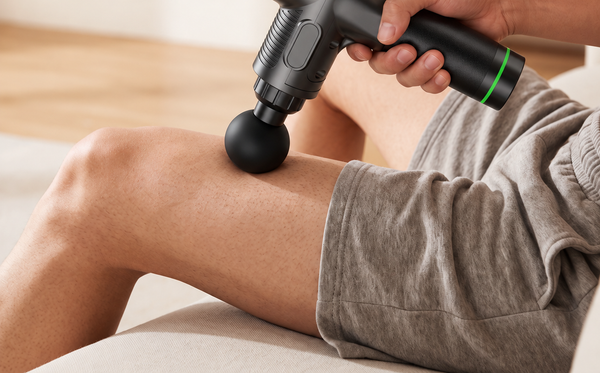
Short answer: after exercise is the most common and least debated use, to loosen a stiff muscle. Right before a strength, speed or jumping effort, it's better to hold off: the studies don't all point in the same direction, and some find a slight drop in performance. Before a gentler activity, a few light passes can accompany your warm-up, without replacing it.
Either way, keep your expectations reasonable: studies on massage guns are still few and small, and mostly involve young athletes.
Before exercise: what can it do?
The most consistent finding is a short-term gain in flexibility and range of motion. Beyond that, two 2023 reviews reach different conclusions:
- the first (11 studies) found no improvement in strength, speed or jumping performance, and sometimes a decrease; its authors advise against using one right before this kind of effort;
- the second (13 studies), on the contrary, reports small immediate gains in strength and flexibility after a session, while stressing that all the studies have quality limitations.
In practice: if you use one before sport, keep it brief, at a moderate intensity, alongside an active warm-up (a few minutes of gradually building movement). Avoid it in the minutes before a sprint, a jump or a heavy lift.
After exercise: what can you expect?
This is when it's used most, to loosen a stiff or tender muscle. Results on stiffness and recovery are mostly positive but mixed, and the second 2023 review links several sessions to a decrease in perceived pain. On the other hand, studies find no effect on blood lactate levels: the idea that it "flushes out lactic acid" has not been shown.
Massage in general is among the techniques that reduce muscle soreness the most in studies, but these mainly involve manual massage. For massage guns, it's therefore a comfort tool, not a guarantee of faster recovery.
How long should you use it?
There is no established duration, and study protocols vary. Usage guidance mentions a few minutes per area, moving the device slowly; the maximum duration stated in your device's user manual remains the reference. The technique is covered in detail in our guide how to use a massage gun.
Massage guns and muscle soreness
Muscle soreness goes away on its own within a few days. On a sore muscle, a massage gun can be used gently if it feels pleasant: low intensity, without pressing, avoiding staying on a very tender spot. It doesn't stop soreness from developing. For other helpful steps when your muscles are tired, see tired muscles after exercise: what helps?
Mistakes to avoid
- Going to maximum intensity right before an explosive effort.
- Using it instead of a warm-up or cool-down.
- Pressing hard on a very painful muscle, thinking it will "work out" the soreness.
- Using it on a recent injury.
When shouldn't you use it?
- On bones, joints, the spine, the front of the neck or damaged skin, before or after sport.
- If you feel sudden sharp pain during exercise, or notice swelling or bruising: it may be an injury, so get medical advice.
- If you have a known health condition or unexplained pain: ask a healthcare professional first.
Komua 02 · Massage Gun follows the same rules: preferably after exercise, at a low intensity to start, never on bones or joints.