Sleeping on your side is a very common position. To keep it comfortable all night, three things matter most: the height of the pillow under your head, the gap between your knees, and how your lower back is positioned.
Here is how to set up this position simply, with what you already have or with a few suitable cushions. This is about comfort: if pain lasts, the last section explains when to seek advice.
Why side sleeping needs a little setting up
When you lie on your side, your shoulder creates a gap between the mattress and your head. If the pillow is too low, your head tilts towards the mattress; if it's too high, it tilts the other way. Either way, your neck stays bent for hours, and it's often your neck you feel when you wake up.
Further down, one leg rests on the other. The top knee tends to slide forwards or down towards the mattress, which slightly twists the pelvis. Many people find it more comfortable to keep a cushion between their knees.
Supporting your neck: the right pillow height
The right pillow fills the gap between your shoulder and your head, so your head stays roughly in line with the rest of your body. For neck pain, the UK's National Health Service (NHS) recommends a low, firm pillow and keeping your head at the same level as the rest of your body.
A few pointers:
- broad shoulders usually call for a slightly higher pillow;
- a soft mattress, which your shoulder sinks into, often calls for a slightly lower one;
- a pillow that flattens during the night no longer does its job by morning.
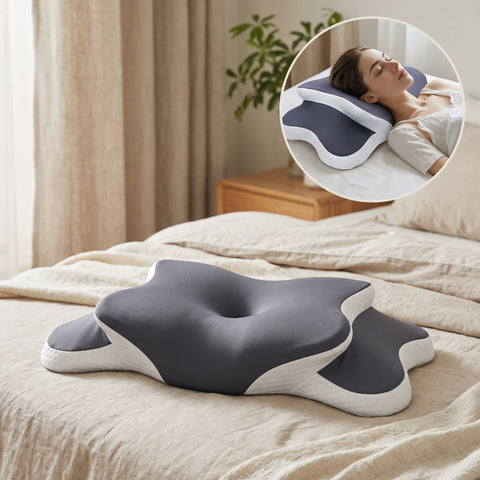
A neck pillow is shaped for this kind of support. Komua 13 · Ergonomic Neck Pillow, made of memory foam, has a central hollow for your head and side wings for side sleeping; its two sides offer two heights, which you choose by turning it over. Allow a few nights to get used to a new pillow shape.
A cushion between your knees: what for?
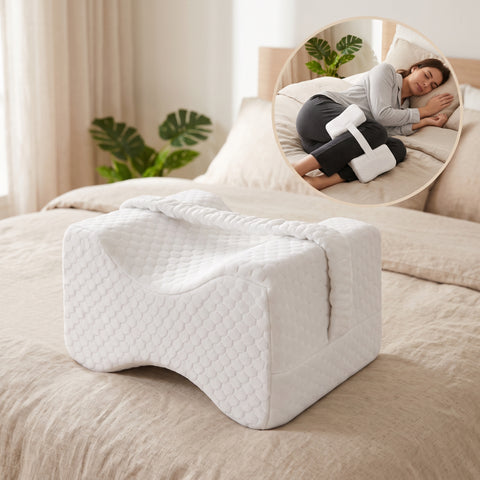
A cushion slipped between your knees keeps a steady gap between your legs. The top knee no longer rests on the other or slides forwards, and your knees no longer touch. It's a matter of comfort, which you adopt or not depending on how it feels.
A folded cushion can do the job, but it tends to escape when you move. An ergonomic knee pillow has two hollows, one for each knee, and an optional elastic strap that helps it stay in place during the night.
What about your lower back?
On your side, your lower back mostly depends on how your legs are positioned and on the mattress: knees slightly bent, a cushion between them, and a mattress that doesn't sag too much at the hips. Some people also like to slip a small cushion under their waist if the mattress is very firm.
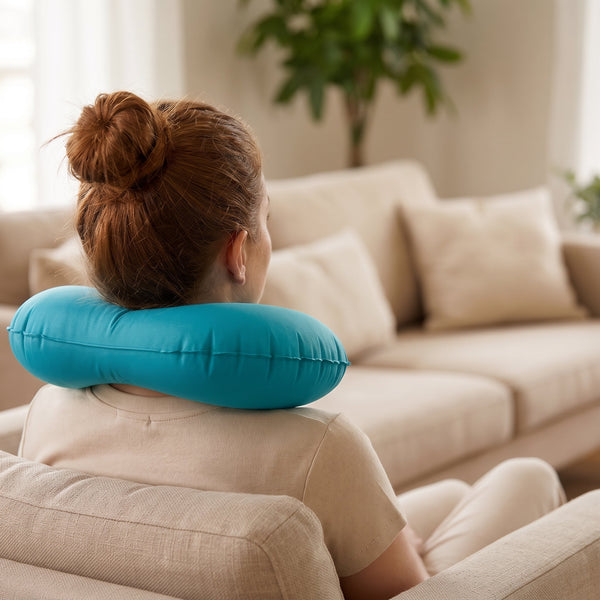
In the evening, before you go to sleep or while you read in bed, your back can also be supported when you're sitting up: that's the role of a lumbar cushion, which fits into the small of your back against a backrest or headboard.
Setting up your position, step by step
- Adjust the pillow height: lying on your side, your head should stay roughly in line with your back, without tilting.
- Bend your knees slightly, without pulling them up to your chest.
- Place a cushion between your knees, thick enough for the top knee to stay roughly level with your hip.
- Keep your arms relaxed: avoid keeping your arm under the pillow or your head all night.
- Switch sides: alternating from night to night, or during the night, is perfectly normal.
What matters most is how you feel when you wake up. If stiffness appears, change only one thing at a time (pillow height, cushion) to work out what suits you.
Neck pillow, knee pillow, lumbar cushion: which to choose?
| What you notice | Option | Good to know |
|---|---|---|
| Your head tilts at night, your neck is stiff in the morning | Neck pillow with two heights | Allow a few nights to adjust |
| Your knees slide or touch | Cushion between the knees | The strap helps keep it in place |
| Your lower back lacks support when you sit up in bed | Lumbar cushion | Also works in the car or on a chair |
All three cushions are part of our comfort and support selection, along with other supports for resting and for the day.
Common mistakes
- Keeping a pillow that's too high or too flat just because you're used to it.
- Stacking two pillows under your head: your neck often ends up bent.
- Pulling the strap of a knee pillow too tight.
- Changing everything at once: it becomes hard to tell what helps.
A comfortable night also starts in the evening: for a quiet moment before bed, see our after-work relaxation routine and, for your neck, our neck and shoulder routine.
When to seek advice?
A pillow or cushion is a comfort accessory: it doesn't treat pain. If neck, back, hip or knee pain lasts several weeks, wakes you at night, gets worse, or comes with tingling or weakness, talk to a doctor.